Service
Vinyl, window and wall lettering in New Jersey
Storefront hours, door decals, frosted privacy film, perforated window graphics and wall lettering, proofed for your approval and installed on site.
Vinyl lettering is cut adhesive film applied to storefront glass, doors, interior walls and equipment to show your name, hours, privacy bands and directions. Lombardo Lettering designs it, proofs it for your approval and installs it at your location in eight New Jersey counties, using premium Avery, 3M or Orafol film and removing old graphics cleanly.
What vinyl lettering covers on storefronts, doors, walls and equipment
Vinyl lettering is solid-color adhesive film cut on a plotter into letters, numbers and flat-color shapes, then transferred to a surface with application tape. On a building, it does a handful of practical jobs: it tells people who you are, when you are open, which door to use and where to go once they are inside. It can also control how much of the room the street can see.
The work splits by surface, and each surface has its own rules for film, prep and removal:
- Storefront glass: business name, hours of operation, phone and web address, logo, and promotional window graphics.
- Doors: hours, push/pull, suite numbers, entrance and exit markings, and the International Symbol of Accessibility where an entrance is accessible.
- Interior glass: frosted or etched-look bands on conference rooms, office partitions, sidelights and shower or sliding doors.
- Walls: lobby logos, mission or value lettering, directional wayfinding, and safety or capacity notices on painted drywall, block and tile.
- Equipment: unit numbers and company identification on machinery, containers and dumpsters. Vehicle work has its own page: see truck lettering and fleet lettering.
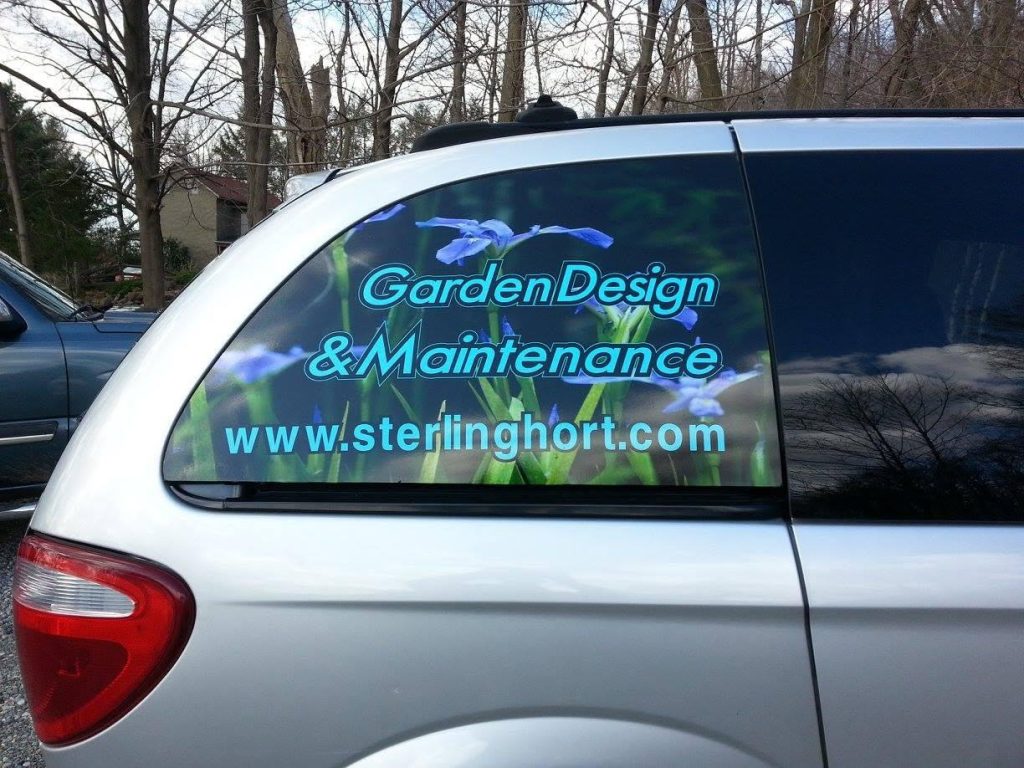
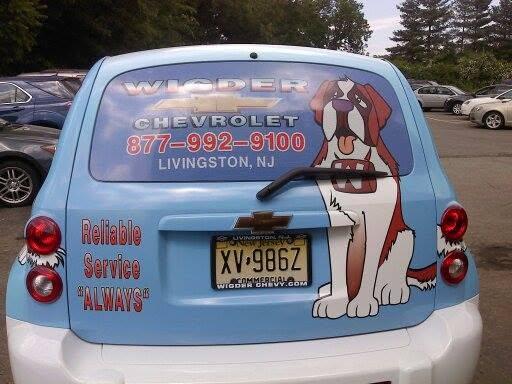
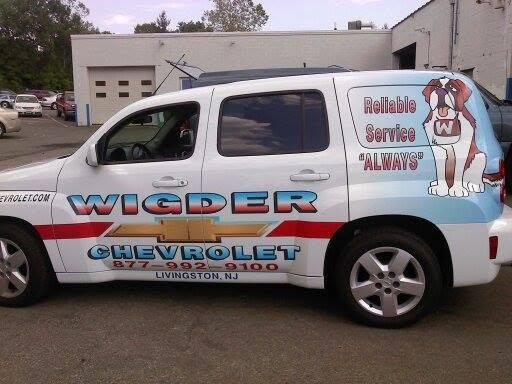
Recent vinyl & window lettering work across New Jersey
Check your town’s window sign rules before designing storefront glass
Window sign limits are written into each town’s zoning or sign ordinance, and two published New Jersey examples show how differently towns handle them.
In Verona, a 6 May 2026 zoning determination for 725 Bloomfield Avenue notes that the applicant was asking the Board of Adjustment for relief from Sec. 150-7.9 V.(14), which limits window signs to no more than 25% of the window area. The same determination cites Sec. 150-7.9 (11), under which temporary signs may not be displayed for more than 30 days (Verona zoning determination).
Morristown’s Ordinance O-42-2018 lists temporary advertising signs affixed to the window of a door as prohibited, but excludes information signs such as push, pull and hours of operation (Morristown Ordinance O-42-2018). Under that 2018 text, door hours and push/pull decals are treated differently from a sale sign stuck to the same pane. Ordinances get amended, so confirm the current version with the town.
Before you plan a full-window graphic, measure the glass, read your town’s sign section or call the zoning office, and design within the limit. A name, hours and a phone number cover a small share of the glass. You can find your county and town on our service areas page, including Verona and Morristown.
ADA rules and door decals: what vinyl can and cannot do
Door lettering often overlaps with the ADA Standards, and it is worth being plain about where vinyl fits. The US Access Board’s guide to Chapter 7 separates signs into two groups (Access Board, Chapter 7 guide).
Signs that identify permanent rooms and spaces, such as restroom, office and room-number signs, and the door labels at exit stairways need both tactile characters and visual characters. Raised characters and braille go 48 inches minimum above the floor, measured to the baseline of the lowest tactile character, and 60 inches maximum, measured to the baseline of the highest, alongside the door on the latch side at single doors. Flat vinyl has no raised characters or braille, so a vinyl-only restroom or room sign does not meet the room-identification requirement. That calls for a fabricated tactile sign, which is a custom sign job rather than a decal.
Directional and informational signs need visual characters only, and that is where vinyl does the job well. Visual characters must contrast with their background, light on dark or dark on light, and have a non-glare finish. The Access Board specifies no minimum contrast level but notes that the higher the contrast, the better. The International Symbol of Accessibility must identify accessible entrances, toilet and bathing rooms, parking spaces, check-out aisles and existing elevators where not all of them are accessible.
So for doors and glass, vinyl handles hours, push/pull, directional arrows, the accessibility symbol on an accessible entrance, and informational notices, set in a matte or satin film with strong contrast.
Frosted, etched, perforated or solid cut vinyl: choosing a window film
Most window jobs come down to one question: who needs to see through the glass, and from which side. The manufacturer datasheets below describe how each film type behaves. The figures are the manufacturers’ ratings for their products, not a Lombardo guarantee.
- Need the name and hours readable, with full view in and out: solid cut vinyl.
- Need privacy with daylight, mostly indoors: frosted or etched film.
- Need a full-color image on the glass and a view out from inside: perforated film.
- Need a short-term sale or event message: check the town’s temporary sign limit first, or use a banner inside the window.
Solid cut vinyl lettering
Opaque letters with clear glass around them. This is the standard for a business name, hours and phone number. It blocks no view beyond the letters themselves and reads from the street on clean glass, which makes it the simplest way to stay inside a town’s window-coverage cap.
Frosted and etched-glass film
Etched-look film diffuses the view while still letting light through, so it is used for privacy bands on offices, conference rooms and bathroom glass, or with a logo cut out of it. ORAFOL’s datasheet for ORACAL 8510 Etched Glass Cal describes a satin-finish film that gives a traditional etched-glass look with consistent light transmission and minimizes glare and reflections. ORAFOL rates that product’s indoor durability as indefinite and its outdoor durability at 7, 5 or 3 years depending on climate zone. The same datasheet notes that films with a structured surface, such as etched ones, show impurities more and need more frequent, careful cleaning.
Perforated one-way window film
Perforated film carries a full printed graphic on the outside while people inside can still see out. Avery Dennison’s MPI 7000 datasheet describes a white film with a black backside, 1.6 mm perforations and a 40% open area, giving good privacy inside with a clear view of the outside. Avery rates its durability at 3 years (MPI 7201) or 2 years (MPI 7301) and recommends overlaminating it. Because it is a printed graphic, the artwork usually starts with our graphic design service.
Glass prep and the risks specific to storefront windows
Glass looks like the easiest surface to letter, but it has failure modes that painted metal does not. 3M’s building windows bulletin covers the main ones (3M Application: Building Windows).
- Heat cracking: 3M warns that glass covered by film with high-opacity areas or dark ink absorbs more heat in sunlight, and the thermal expansion can crack or break the glass. It says not to use such films on glass with significant sun exposure. A sunny, south-facing storefront is a reason to favor cut lettering or lighter films over a dark, full-coverage graphic.
- Invisible coatings: 3M says water beading on the glass means a coating that interferes with adhesion, and its bulletin cleans the glass with a mix of 70% isopropyl alcohol and 30% water.
- Gaskets and silicone: 3M trims film 1/4 in. back from window gaskets and silicone joints, because graphics will not stick there.
- Temperature: 3M gives 54°F to 100°F as the recommended application range, and wet application must be done with the glass above freezing. ORAFOL lists 46°F as the minimum for ORACAL 8510.
- Wet or dry: 3M lists its Dusted and Frosted Crystal Glass Finishes as wet-application films. Avery Dennison does not recommend wet application for perforated film, because water trapped in the perforations obscures the view.
- Seams and edges: 3M recommends overlapping panels, upper over lower on horizontal seams, to avoid light leaks on solid films. Avery butt-seams perforated panels instead and says all exposed edges and seams must be sealed, and 3M says all perforated film installations on glass must be edge sealed.
Why Lombardo
Vinyl & window lettering, done at your yard
We bring the shop to you, so your vehicle keeps working while we do the job. Call Frank for a straight answer, or send a photo and we will reply with a price.
- Mobile — we come to your yard or job site
- Premium Avery, 3M or Orafol cast film
- Layout proofed on your vehicle before anything is cut
Wall graphics on painted drywall, block and tile
Walls are a different problem from glass, and mostly the problem is the paint. 3M’s walls bulletin says low-VOC paints have changed how film adhesives bond to walls, and that there is no single film or adhesive that works best on every paint. 3M directs installers to clean with its Enhanced Adhesion Cleaning Method and run an adhesion test before installing (3M Application: Walls). ORAFOL adds that freshly painted surfaces must be fully cured before application. If you are repainting a lobby before the lettering goes up, tell us the paint date.
Textured masonry has its own limits. 3M says its films must not go on textured walls with loose surfaces such as loose sand-textured block. Films for textured walls work best where grout lines are no more than 1/8 in. deep and flush, concave or V-shaped; shallower lines are bridged and conformed with heat and a roller, and deeper lines are trimmed in a mosaic technique. Multi-panel walls use a 1/2 in. overlap.
For the design, wall lettering follows the same contrast logic as window work. A logo and one line of text at reception, room names and arrows in the hallways, and capacity or safety notices where people will actually stop and read them.
How Lombardo handles a vinyl lettering job at your location
Lombardo Lettering is a family business founded in 1940 by Frank Lombardo Sr., an army veteran who painted signs, pinstripes and murals. Frank Lombardo Jr. moved the business into cut vinyl, printed wraps and adhesive graphics, and his son Tristan works alongside him as the third generation.
The work is mobile. We install at your location, whether that is a storefront, yard, job site or municipal garage, and there is no shop drop-off. You see and approve a proof before anything is cut. Lettering is cut from premium Avery, 3M or Orafol cast film, not cheap calendered vinyl, and old graphics are removed cleanly. If a few lines of door lettering will do the job, that is what we will recommend instead of a larger graphic.
We serve Morris, Essex, Warren, Union, Bergen, Somerset, Sussex and Hunterdon counties. The shop is at 95 W Main St, Chester, NJ 07930, off Route 206 and Route 24, and visits there are by appointment.
Cleaning, power washing and removing window and wall vinyl
Vinyl can come off, provided it is removed the right way for the surface. 3M’s removal bulletin says not to use heat-aided removal on glass, because heat can break it. For decorative films on glass, 3M uses a solution of at least 2 teaspoons of baby shampoo or dish detergent per quart of water and says not to use heat or chemicals on glass. On other surfaces, warming the graphic to 160–200°F softens the adhesive, and 3M recommends a low peel angle for its perforated window films (3M Removal bulletin). See our decal removal page for taking off old lettering.
For cleaning, 3M’s maintenance bulletin caps power washing at 1,200 psi, because higher pressure forces water under the film and causes lifting and curling. It also says not to pressure-wash perforated window films without edge sealing tape (3M Maintenance bulletin). If a building service washes your storefront, pass that number on. ORAFOL also says structured films such as etched ones need careful, more frequent cleaning.
When you are ready for a price, send the wording, a photo of the glass or wall and rough measurements through our quote page, or call Frank at 973-214-2292. You can also email franksignguy@yahoo.com.
Our work, up close
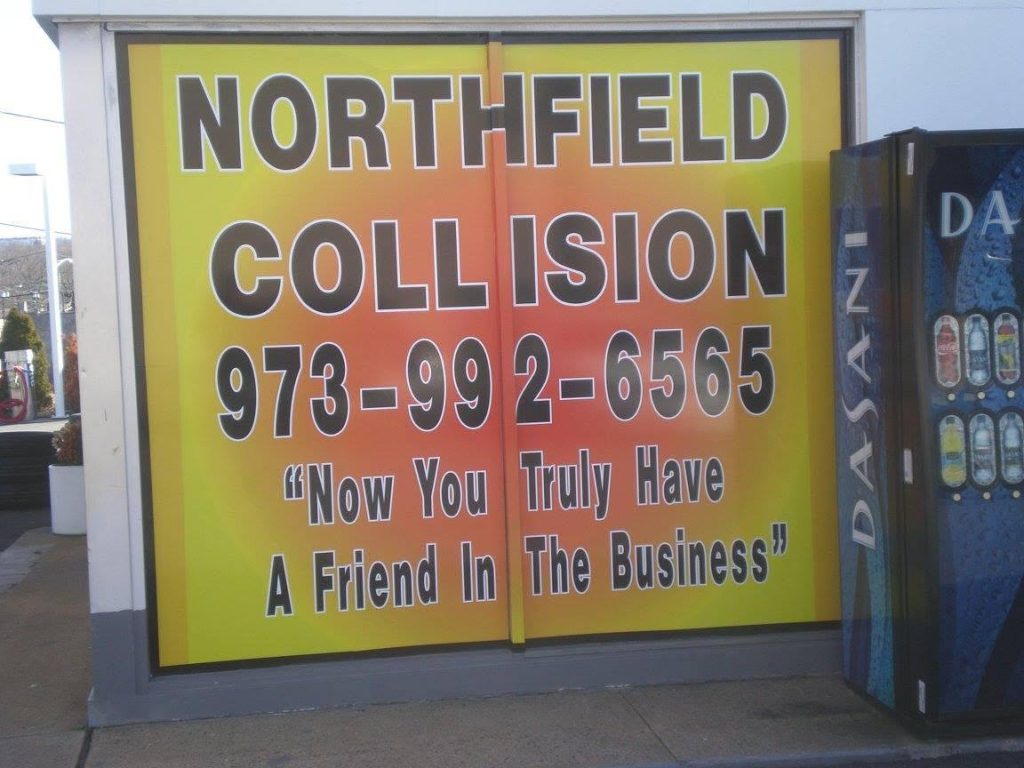
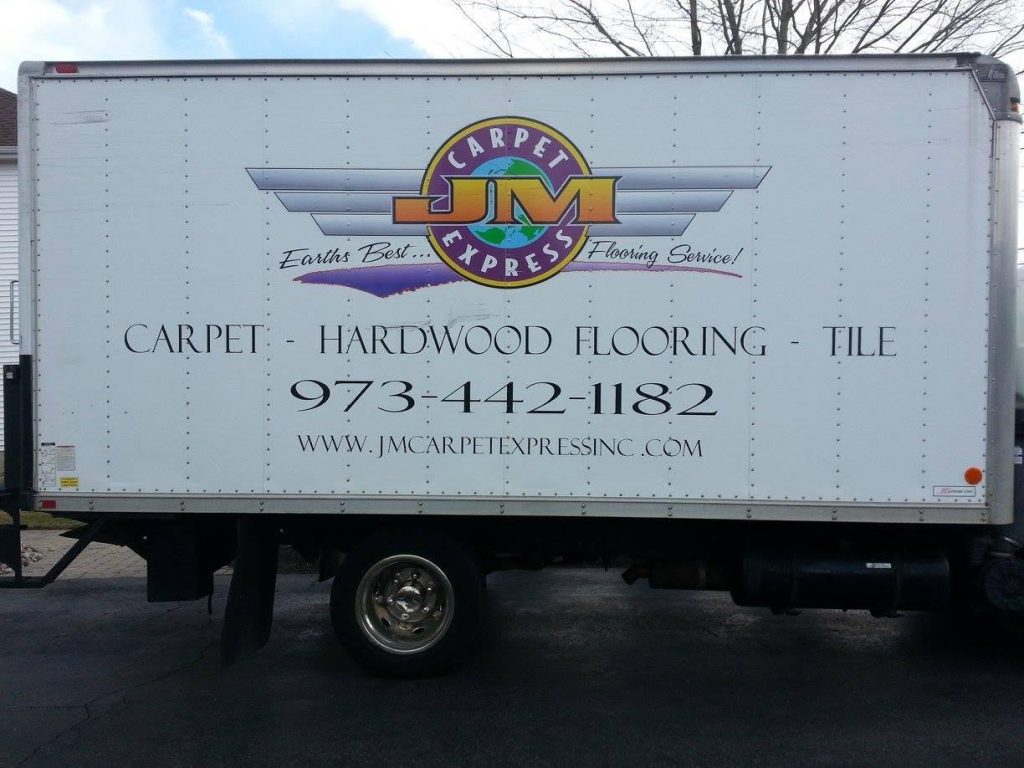
Vinyl lettering questions
Can vinyl lettering be used for an ADA restroom sign?
Not on its own. The US Access Board says signs identifying permanent rooms and spaces, including restrooms, need tactile characters as well as visual ones, mounted 48 to 60 inches above the floor to the character baselines, on the latch side at single doors. Flat vinyl has no raised characters or braille. Vinyl works for visual-only signs: directional arrows, informational notices, hours and the accessibility symbol on an accessible entrance.
How much of my storefront window can I cover?
It depends on your town. Verona’s code, as cited in a 2026 zoning determination, limits window signs to 25% of the window area and temporary signs to 30 days. Morristown’s 2018 ordinance prohibits temporary advertising on door glass but allows hours and push/pull signs. Check your town’s current sign ordinance or call the zoning office before designing a large graphic.
What is the difference between frosted film and perforated window film?
Frosted or etched film diffuses the view in both directions while letting light through, so it suits offices and conference rooms. Perforated film carries a full printed image on the outside while people inside still see out; Avery Dennison’s MPI 7000 has a 40% open area. Frosted is mainly for privacy, perforated is mainly for advertising on glass.
Can dark window graphics crack the glass?
They can. 3M warns that film with high-opacity areas or dark ink absorbs more heat in sunlight, and the resulting thermal expansion can crack or break the glass. 3M says not to use such films on glass with significant sun exposure. On a sunny storefront, cut lettering or lighter films are the safer choice.
Will wall vinyl stick to freshly painted walls?
Not until the paint is fully cured, according to ORAFOL. 3M also notes that low-VOC paints have changed how film adhesives bond, and that no single film works best on every paint, so it recommends an adhesion test before installing. Tell us when the wall was painted and what paint was used when you ask for a quote.
Can old window lettering be removed without damaging the glass?
Yes, when it is removed correctly. 3M says not to use heat on glass because it can break it, and to remove decorative films on glass with a detergent and water solution instead. 3M recommends a low peel angle for its perforated window films. Lombardo removes old graphics cleanly before new lettering goes on; see our decal removal page.
Can I power wash my storefront with vinyl lettering on it?
Yes, with limits. 3M’s maintenance bulletin caps power washing at 1,200 psi, because higher pressure drives water under the film and causes lifting and curling. It also says perforated window films should not be pressure-washed unless the edges are sealed with edge sealing tape. Share those limits with whoever cleans your windows.
Do I need to come to your shop for window or wall lettering?
No. Lombardo Lettering installs at your location in Morris, Essex, Warren, Union, Bergen, Somerset, Sussex and Hunterdon counties, and you approve a proof before anything is cut. Visits to the shop at 95 W Main St in Chester are by appointment. Call Frank at 973-214-2292 or use the quote page to start.
Ready for a quote?
Call 973-214-2292 and talk to Frank directly.
Areas we serve across New Jersey
Eight counties. Pick yours to see the towns we cover. Mobile truck lettering, wraps and signs — we come to your yard.
Find us in Chester, NJ
Our shop is at 95 W Main Street, Chester, New Jersey 07930 — but for lettering and wraps, we come to you.
Our mobile service area
Eight counties across northern and western New Jersey, covered by our own trucks.