Service
Truck and vehicle lettering in New Jersey
Cast-vinyl lettering for pickups, vans, box trucks and trailers, laid out on your actual vehicle and applied where it is parked.
Yes. Lombardo Lettering letters pickups, vans, box trucks and trailers at your yard, driveway or job site in Morris, Essex, Warren, Union, Bergen, Somerset, Sussex and Hunterdon counties. We lay the design out on a template of your actual vehicle, you approve the proof, then we cut it from Avery, 3M or Orafol cast film and apply it there.
What truck lettering is, and how it differs from printed graphics
Truck lettering is text and simple shapes cut from solid-color adhesive vinyl on a plotter, then weeded, masked with application tape and pressed onto the body panel. Each color is its own layer of film. There is no printing involved, so a white name on a red door is white vinyl, not ink.
That is different from a printed graphic, where an image is printed onto white film and then laminated. Printing is the right tool when the artwork has photographs, gradients or fine color blends. Cut vinyl is the right tool for company names, phone numbers, trade lines, DOT numbers and flat-color logos. Most work trucks need only cut vinyl, and a few need a printed logo panel combined with cut lettering.
Lombardo Lettering is a family business that started in 1940, when Frank Lombardo Sr. painted signs, pinstripes and murals by hand. Frank Lombardo Jr. took the shop into cut vinyl, printed wraps and adhesive graphics, and his son Tristan now works alongside him. The layout habits come from sign painting. The materials are modern film.
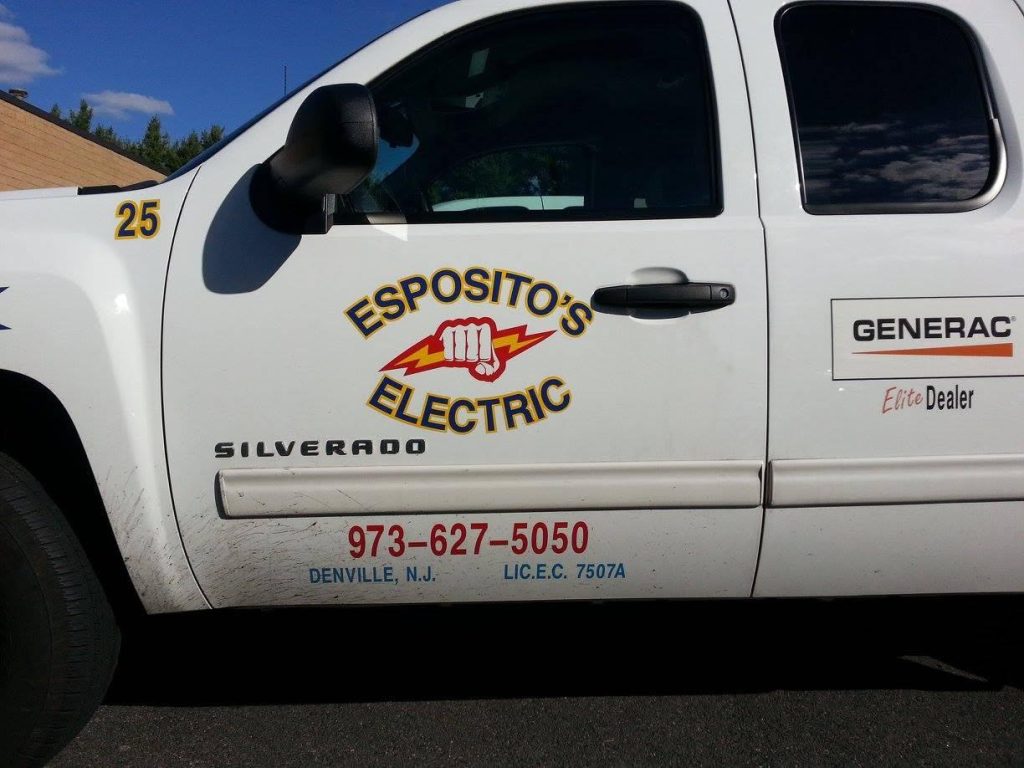
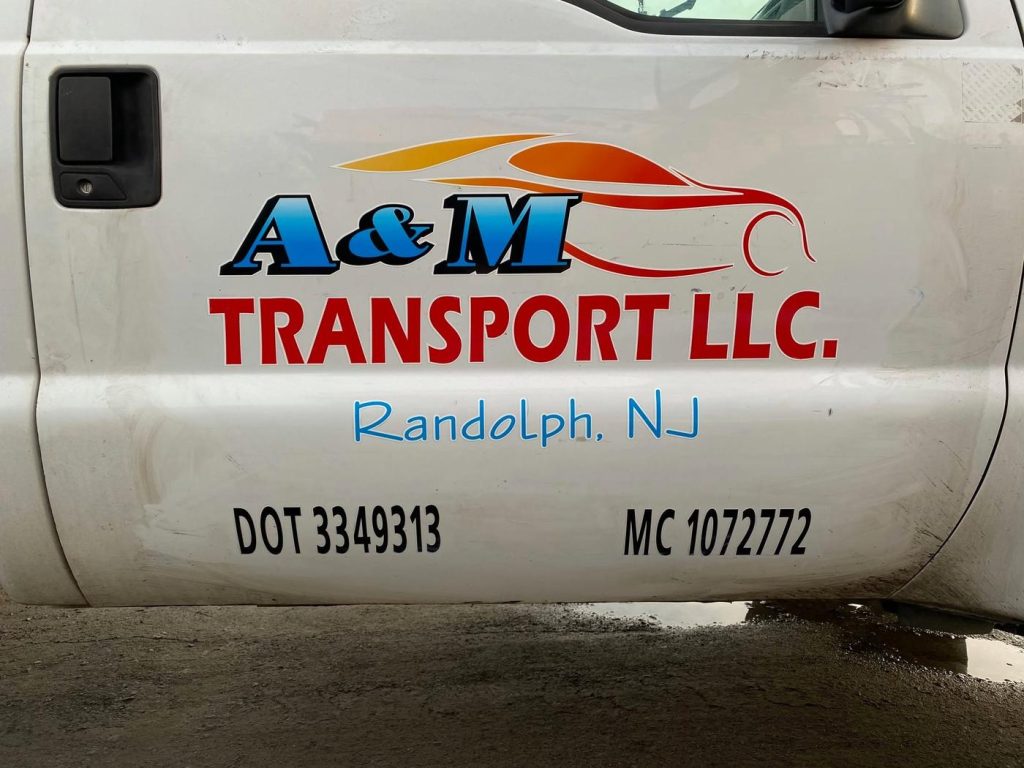
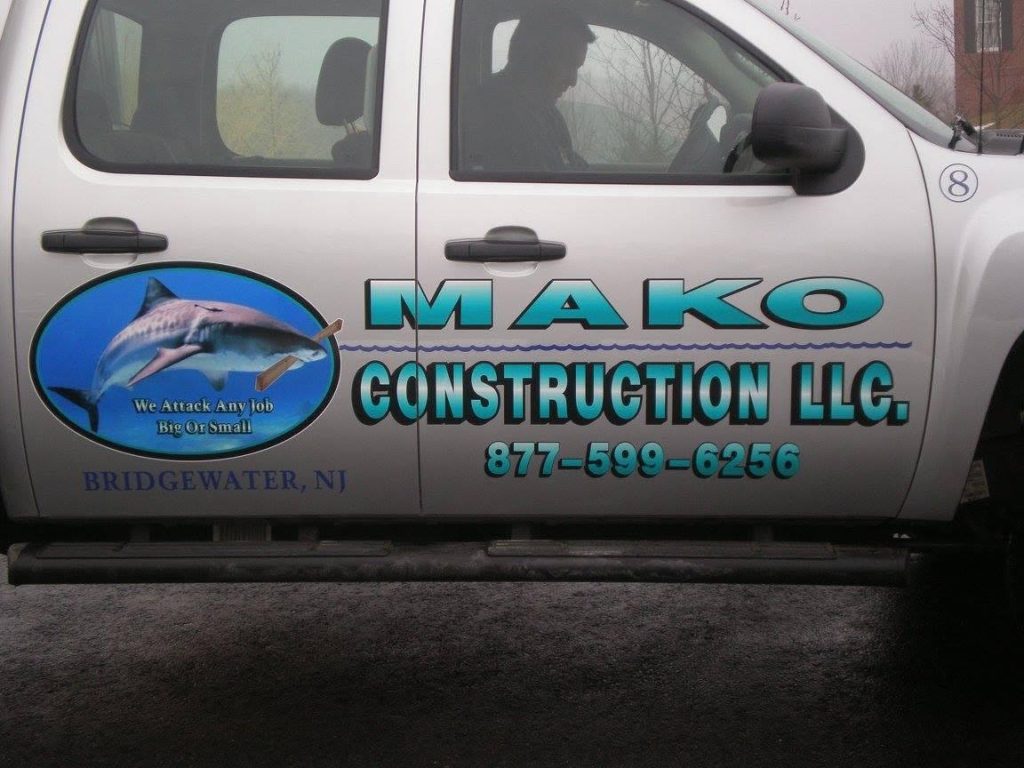
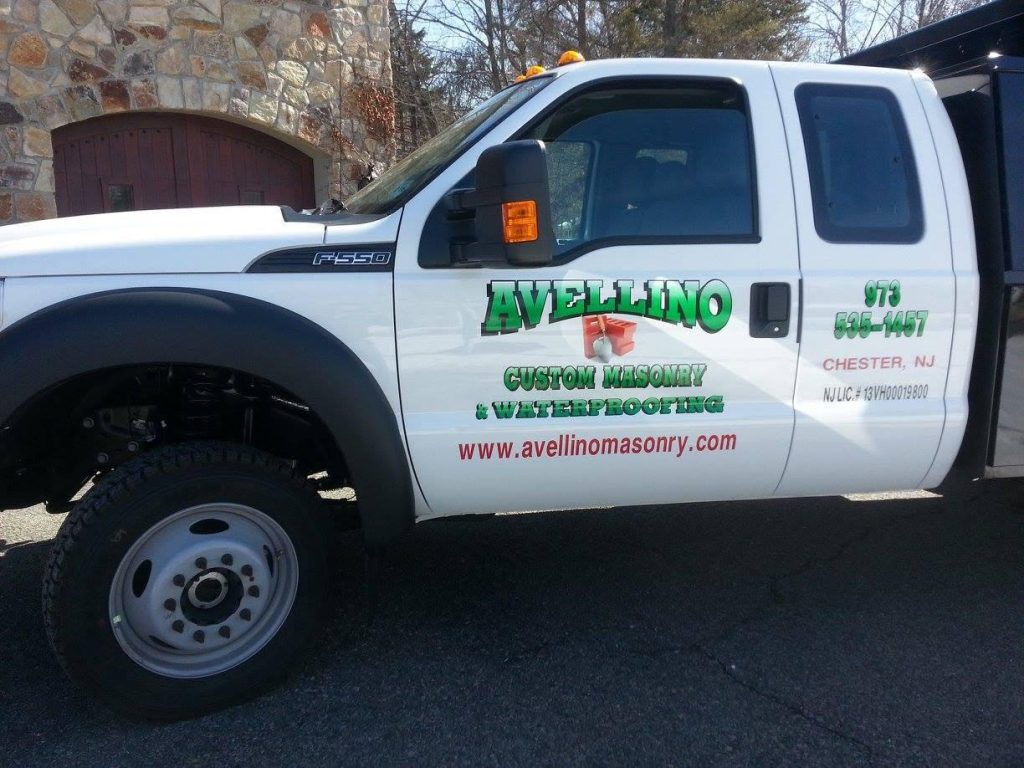
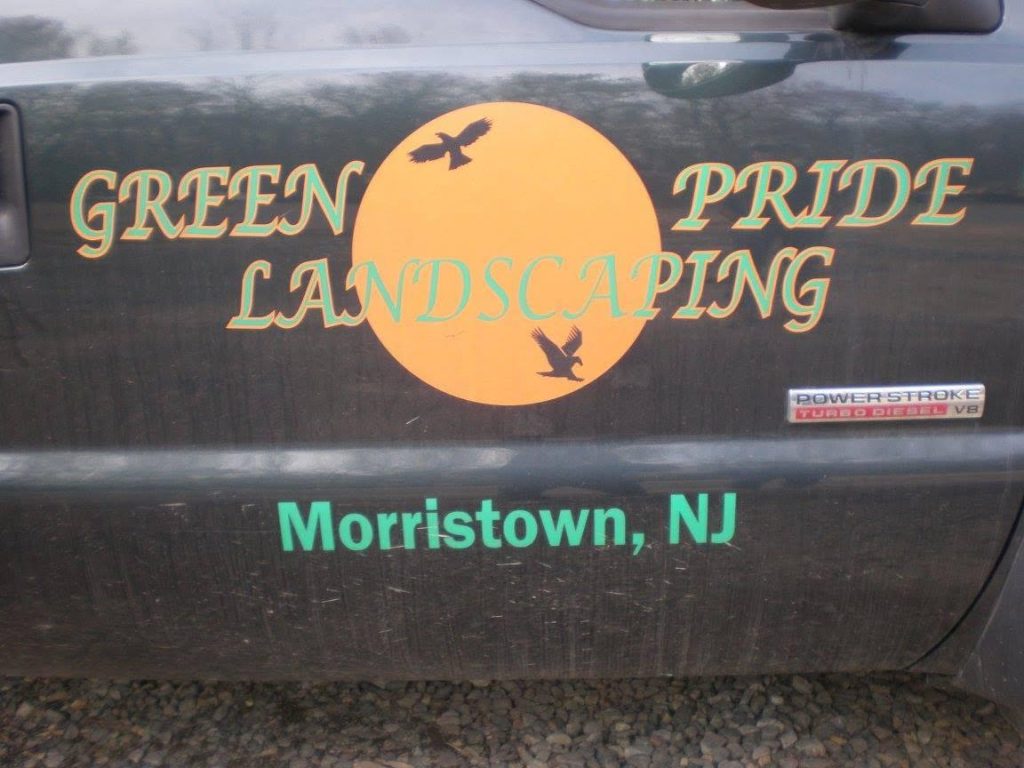
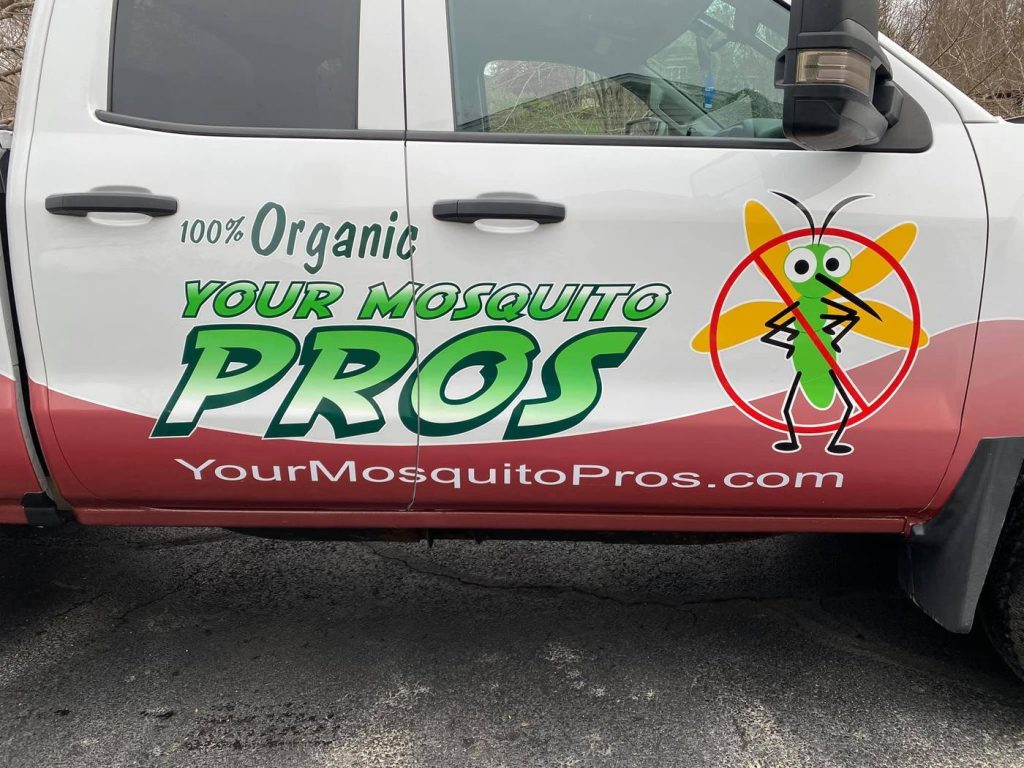
Recent truck lettering work across New Jersey
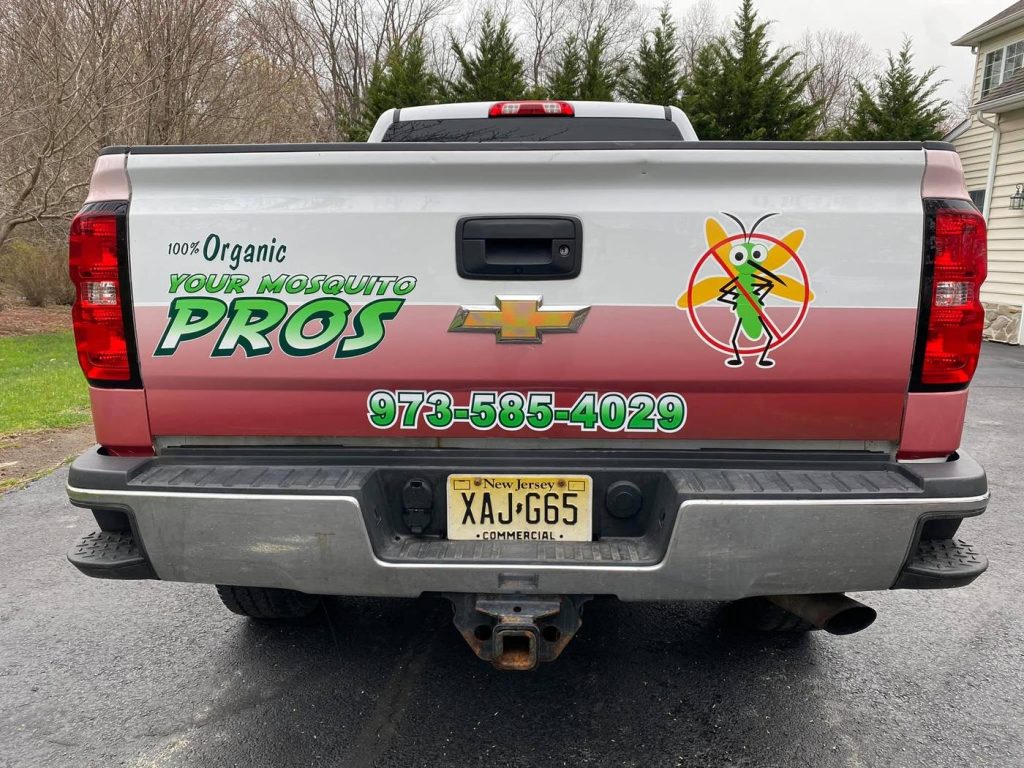
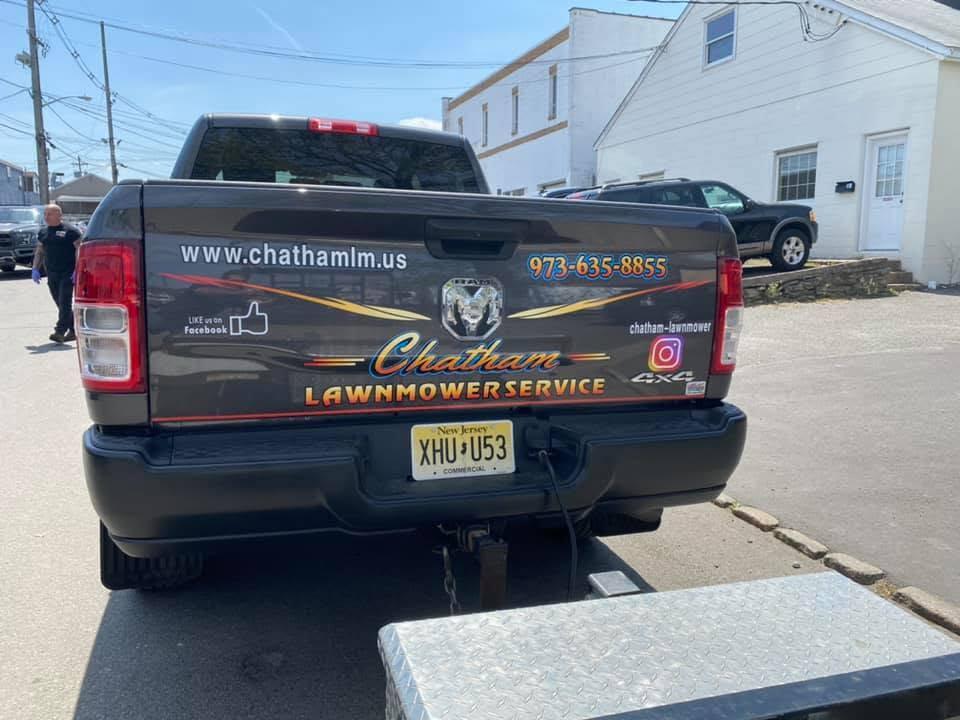
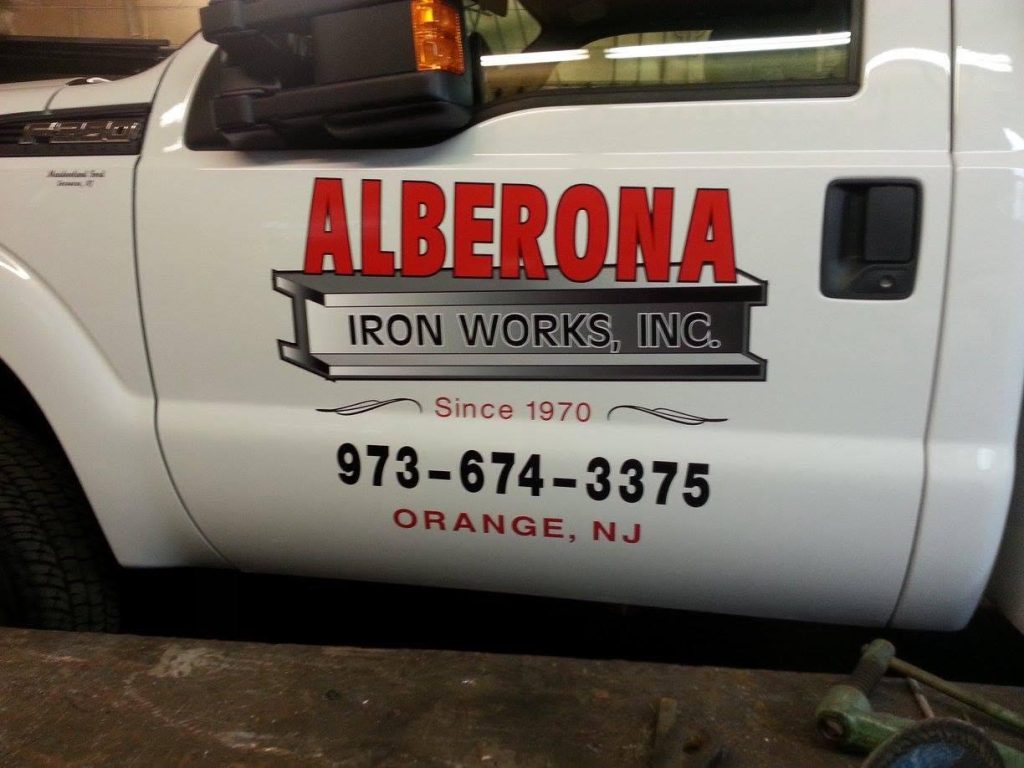
Where lettering goes on pickups, vans, box trucks and trailers
Each body style has a few panels that can carry clean, readable lettering and a few that fight it. We plan around the panel lines, handles, fuel doors and rivets of your specific vehicle rather than a generic outline.
Pickup trucks
The doors carry the company name, trade and phone, because they are the panels people see at a gas pump or a curb. The tailgate is the best spot for a phone number or website, since that is what the driver behind you reads in traffic. Bed sides can take a longer trade list if the doors are crowded. Body lines and door handles set the usable height, which is why we template the actual truck.
Cargo vans
Van sides give you a large flat field, so the name can run big and the service list can sit under it. Sliding-door seams cut across that field, and we set the layout so no word breaks across a gap. The rear doors work like a pickup tailgate, with the phone and web address split cleanly across the two doors.
Box trucks
A box body has the largest flat sides on the road, but many are built from riveted or corrugated panels. That surface is one of the main reasons film choice matters, which we cover below. The cab doors usually carry the legal identification while the box carries the marketing.
Trailers
Enclosed trailers letter much like box trucks. For a truck and trailer that travel together, New Jersey’s name-display rule is satisfied if either unit carries the required lettering, so you can decide which one gets the legal ID and which gets the advertising.
What New Jersey and FMCSA require on a commercial vehicle
Legal identification is part of most truck lettering jobs. We size and place it as part of the layout, but the rules belong to the state and federal agencies, so here is what they actually say. For anything specific to your operation, check with the agency or your attorney. Our NJ vehicle lettering law page goes further into the details.
Under N.J.S.A. 39:4-46(a), a vehicle used for commercial purposes on a street or highway must display the name of the owner, lessee or lessor and the municipality of the principal place of business, in plain view and not less than three inches high. Passenger automobiles and pharmacy drug-delivery vehicles are excepted. Where vehicle design or other required markings limit the space, the lettering must be as close to three inches high as possible, provided the name stays clearly visible and readily identifiable.
Further rules apply as the vehicle or fleet gets larger:
- Franchised public utilities and fleets of 50 or more commercial vehicles may display a corporate identification number instead of the municipality name.
- At 26,001 lb GVWR or GCWR and above, for vehicles registered or principally garaged in New Jersey, N.J.S.A. 39:4-46(b) adds the GVWR to the required display. Knowingly displaying a GVWR lower than the actual one can bring a fine of up to $5,000, up to 90 days in jail, or both, for each offense.
- N.J.A.C. 13:60-2.1 defines an intrastate commercial motor vehicle to include one with a GVWR, GCWR or registered weight of 10,001 lb or more, and says it must not operate without USDOT registration and an active USDOT number.
- The federal marking rule, 49 CFR 390.21T, calls for the carrier’s legal name or a single trade name and the number preceded by “USDOT” on both sides of a self-propelled commercial motor vehicle, in letters that contrast sharply with the background and are readily legible in daylight from 50 feet while the vehicle is stationary.
Designing truck lettering that reads at a distance
The only official legibility test we found is the federal one for USDOT markings: readable in daylight from 50 feet with the truck parked. That is a useful floor for every line on the truck, not only the USDOT number. In practice it pushes the design toward a few habits.
Contrast does most of the work. Dark letters on a light body or light letters on a dark body, with an outline or shadow only when the body color sits close to the letter color. Bold, open typefaces hold up better than thin scripts, which close up at a distance. One name, one trade line and one phone number will read; seven bullet points of services will not.
It also pays to keep the legally required text apart from the marketing text. The name and municipality, USDOT number and GVWR sit where they are easy to find and at the required size, and the logo, services and web address are arranged around them. Kept separate, a later change to a phone number or service list never touches the compliance lettering.
Our graphic design work covers clean-up of a rough logo or a new one, so the truck, your custom signs and your shirts and apparel all use the same artwork.
Cast versus calendered vinyl: what the manufacturer datasheets say
Much of the difference between lettering that stays down over rivets and body lines and lettering that lifts comes from the film. The two main families are cast and calendered PVC, and manufacturers publish how they differ.
How each film is made
Avery Dennison describes calendered PVC as melted and compounded under heat and pressure, then forced through a set of temperature-controlled rolls, with typical thicknesses of 80-100 microns. For cast PVC, the ingredients are blended with a solvent, poured onto a casting sheet and carried through ovens that evaporate the solvent. Avery says the internal tension of cast film is very low, which gives it very high flexibility and very little shrinkage, even at elevated temperatures. Its vinyl glossary puts the practical difference simply: calendered film is usually used for flat surfaces or simple curves, and cast film is the more conformable choice for curved surfaces.
Rated outdoor durability, film by film
Durability ratings are published per product and per color, for vertical outdoor exposure. ORACAL 651, an intermediate calendered film, is rated 6 years for colors, 4 for metallics and 3 for brilliant blue. ORACAL 751C, a high-performance cast film, is rated 8 years for black and white, 7 for colors and 5 for metallics. Avery Dennison SC 900 Super Cast, sold for advertising and fleet marking, is rated 12 years for black and white and up to 10 years for colors. Those are the manufacturers’ figures under their own test conditions, not a promise about any particular truck.
Where each film belongs on a truck
Read honestly, the datasheets say calendered film is a reasonable product for flat surfaces: Orafol lists 651 for flat, medium-term car, truck, van and trailer graphics. Cast film earns its place on the parts of a work truck that are not flat, such as rivets, corrugated box sides, recessed panels and door body lines. Avery lists SC 900 for flat surfaces, flat with rivets, corrugations and deep recesses, and for trucks and trailers, heavy equipment, and buses and transit. Lombardo uses premium cast films from Avery, 3M or Orafol and does not use cheap calendared vinyl, so one material spec covers every panel on the truck.
Why Lombardo
Truck lettering, done at your yard
We bring the shop to you, so your vehicle keeps working while we do the job. Call Frank for a straight answer, or send a photo and we will reply with a price.
- Mobile — we come to your yard or job site
- Premium Avery, 3M or Orafol cast film
- Layout proofed on your vehicle before anything is cut
How Lombardo letters a truck at your yard
Every job runs through the same steps, and the vehicle never leaves your property.
Paint condition matters too. 3M recommends that installers complete a signed pre-installation inspection record noting loose paint, dents, fillers, rust or blistered paint, because film can only hold as well as the paint under it. Point out any repaired or repainted panels when you send photos.
- You call Frank at 973-214-2292 or send the vehicle, wording and a photo through the quote form.
- We lay the design out on a template of your actual vehicle and send you the proof. Nothing is cut until you approve it.
- Old lettering comes off cleanly first; see decal removal for that part.
- The panels are cleaned right before the film goes down. 3M’s vehicle procedure is a dish-detergent wash and rinse, a thorough dry, a wipe with a solvent-based cleaner to lift wax, then a wipe with 70% isopropyl alcohol and 30% water, with the graphic applied immediately after.
- The lettering is positioned, squeegeed down, and worked around rivets and edges.
Why New Jersey weather sets the schedule
Mobile application happens outdoors, so temperature is part of the plan. 3M’s vehicle bulletin says it is best practice to apply when both the air and the vehicle surface are between 60 and 90°F. Below that range the initial bond may be insufficient and moisture can condense on a panel that is below the dew point; above it the graphic may pre-adhere and trap air. Avery lists a 40°F minimum application temperature for SC 900, but 3M also advises keeping the vehicle above 60°F for at least 12 hours afterward before it sees cold or wet weather. On a cold or wet day, the better plan is a new date or an indoor space on your property, not vinyl over a damp panel.
Washing, winter care and eventual removal of truck lettering
3M’s vehicle application bulletin says not to wash the vehicle for at least 24 hours after installation. After that, wash by hand or in a touchless car wash; 3M notes that brushes can catch a loose edge and dull the finish. If you pressure wash, 3M’s limits are a 40-degree or wider spray pattern with a tip guard, no more than 1,200 psi, and the nozzle held at least 12 inches away and perpendicular to the graphic, never aimed at a low angle into an edge. Through a New Jersey winter, that means rinsing road grime off by hand rather than running the truck through a brush wash.
3M also notes that as outdoor graphics age, they gradually lose gloss, shift slightly in color and can lift at edges or around rivets, and it does not treat those changes as product failure. Checking the edges after each wash lets you catch lifting early.
When the truck is sold or the business changes, film is removed with heat. 3M’s removal bulletin calls for warming the graphic uniformly to 160-200°F, lifting a corner and pulling, and never using heat on graphics applied to glass. How cleanly it comes off depends on what is underneath: slightly oxidized paint develops higher adhesion than new paint, film applied before fresh paint has cured is difficult to remove, and film aged by sun and heat turns brittle and tears. 3M does not warrant against damage to paint or clear coats during removal, which is why the paint’s condition at installation is worth recording.
Choosing between lettering, a wrap and a fleet program
Lettering is the right answer when the truck’s own paint color works for your brand and the message is a name, a trade and a way to reach you. It covers the legal identification and leaves most of the paint visible.
A vehicle wrap makes sense when you want to change the body color, cover most of the vehicle in printed artwork, or hide a mismatched color on a used truck. Lombardo will not upsell a full wrap when lettering would do the job.
A fleet lettering program fits when you run several trucks and want each new one to match the last, with the same layout, film and placement of required numbers. For signs on buildings, windows or walls, see vinyl lettering and banners.
To get a quote, call Frank at 973-214-2292, email franksignguy@yahoo.com, or use the quote form with the vehicle type, the wording and a photo. Shop visits at 95 W Main St in Chester are by appointment; the lettering itself is done at your location. See service areas for the towns we cover in each county.
Our work, up close
Truck and vehicle lettering questions
Do I have to bring my truck to your shop?
No. Lombardo Lettering is mobile and does not take shop drop-offs. We letter at your yard, driveway, job site or municipal garage anywhere in Morris, Essex, Warren, Union, Bergen, Somerset, Sussex and Hunterdon counties. The shop at 95 W Main St in Chester is open for visits by appointment if you want to talk through a design in person.
How big does the lettering on a commercial truck have to be in New Jersey?
N.J.S.A. 39:4-46(a) calls for the owner, lessee or lessor name and the municipality of the principal place of business, in plain view and not less than three inches high. Where vehicle design or other required markings limit the space, the lettering must be as close to three inches as possible while the name stays clearly visible. Vehicles at 26,001 lb GVWR or more registered or garaged in New Jersey must also display the GVWR.
Does my pickup need a USDOT number on the doors?
It depends on weight and use. N.J.A.C. 13:60-2.1 treats intrastate vehicles with a GVWR, GCWR or registered weight of 10,001 lb or more as commercial motor vehicles that need USDOT registration and an active USDOT number. The federal marking rule calls for the legal name and USDOT number on both sides, readable from 50 feet in daylight. Confirm your status with FMCSA or the state, and we will lay the numbers out to that spec.
Why use cast vinyl instead of cheaper calendered vinyl?
Cast film is poured and oven-dried rather than forced through rollers, so it carries very little internal tension and shows very little shrinkage, which helps it conform over rivets, corrugations and body lines. Calendered film is usually used on flat surfaces or simple curves. Manufacturer ratings also differ: ORACAL 651 calendered is rated 6 years for colors, while Avery SC 900 cast is rated up to 10 years for colors, vertical exposure.
Can you letter my truck in winter?
Sometimes. 3M recommends applying vehicle graphics when both the air and the vehicle surface are 60 to 90°F, and keeping the vehicle above 60°F for 12 hours afterward. Below that range, moisture can condense on the panel and the initial bond may be weak. In the colder months the date is set around the forecast, or the work moves into a heated garage if your property has one.
Will removing the lettering later damage my paint?
Usually it comes off cleanly with heat, but nobody can guarantee it. 3M does not warrant against paint or clear-coat damage during removal, because results depend on the surface. Slightly oxidized paint holds the adhesive harder than new paint, film applied over uncured paint is difficult to remove, and film aged by sun and heat gets brittle. Recording the paint condition before installation gives you a baseline.
How should I wash a lettered truck?
Wait at least 24 hours after application. After that, hand wash or use a touchless wash, since brushes can catch a loose edge. If you pressure wash, 3M’s limits are a 40-degree or wider nozzle with a tip guard, no more than 1,200 psi, held at least 12 inches away and perpendicular to the graphic.
Can you match lettering already on my other trucks?
Yes. Send a clear photo of a lettered truck and we will lay out the new vehicle to match its layout, typeface and colors. The proof on a template of the new vehicle shows you the match before anything is cut. If you keep adding trucks, a fleet lettering program keeps one spec for every vehicle.
Ready for a quote?
Call 973-214-2292 and talk to Frank directly.
Areas we serve across New Jersey
Eight counties. Pick yours to see the towns we cover. Mobile truck lettering, wraps and signs — we come to your yard.
Find us in Chester, NJ
Our shop is at 95 W Main Street, Chester, New Jersey 07930 — but for lettering and wraps, we come to you.
Our mobile service area
Eight counties across northern and western New Jersey, covered by our own trucks.